
Things I never did and (probably) will never do.
Also, not to be too morbid, how whole worlds disappear when we die. Still better than leaving this world as an empty vessel.

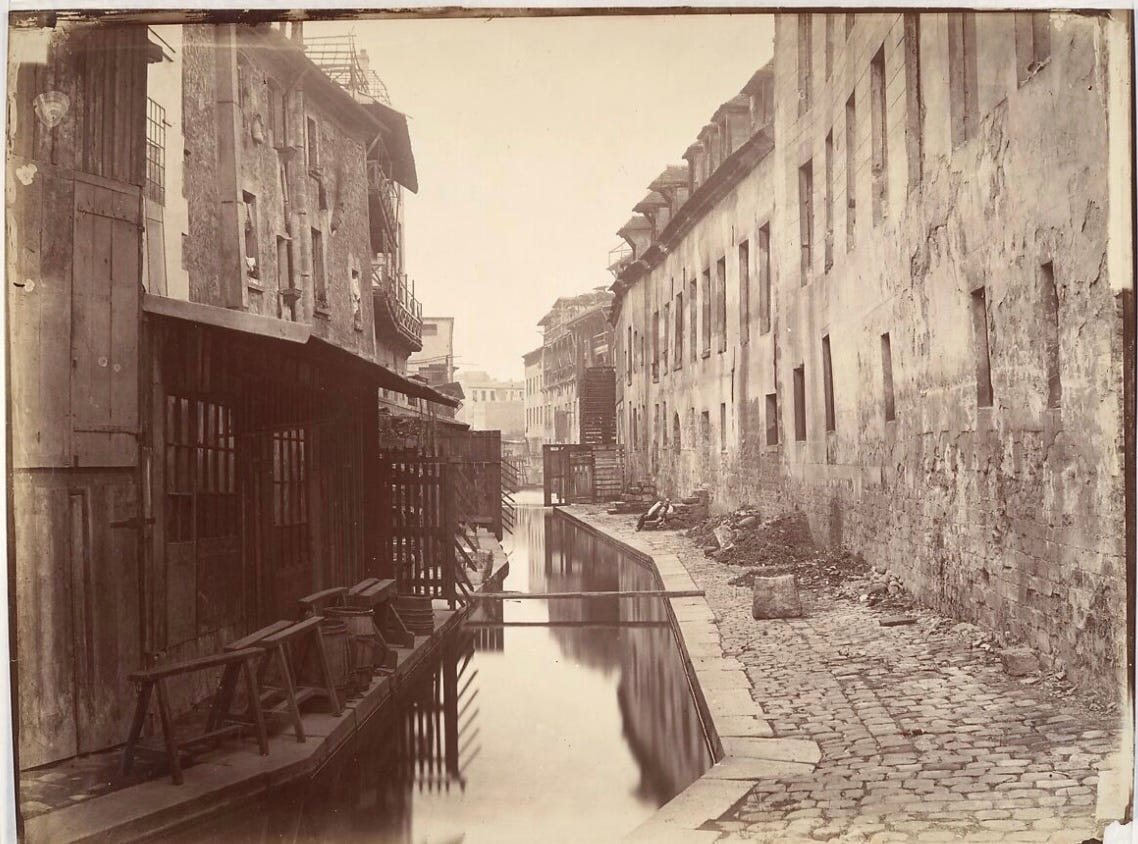
I got a shock this morning as I was reading the New York Times online, although it wasn’t because of anything in the news. There in the Book Review section was a review of a new novel by Lisa Robertson entitled “Riverwork.” What gave me a start is that the book’s “nominal subject,” as the reviewer put it, was the Bièvre, a “lost” river buried under Paris (although it surfaces in a few places and there has been talk for years of restoring it and bringing parts of it back to life.)
On reading further it turned out, to my relief, that the book wasn’t really about the Bièvre, but used that river as the setting for what the reviewer called “a collection of labyrinthine acrobatic lexical maneuvers delivered with the unadulterated confidence of the unhinged.” Speaking as a writer, my own ambitions have never stretched quite that far.
I say it was a relief because, during much of the 30 years my wife and I lived in Paris, I had the idea of doing something—an article, a book chapter, a book, who knows what—about this underground river and its history. Indeed, even after we moved back to the United States around 2017, I kept the thick folder of materials I had collected about the Bièvre, thinking that it might still make up a chapter (or part of a chapter) for a long-planned book about my adventures in Europe and other parts of the world during that long period of expatriatism.
Who knows if I will ever write the chapter or the book before I die and take my experiences and ideas with me to the grave.
That is what this post is really about, in case you were wondering. I think about death a lot, and not just more recently now that I am a senior citizen on Medicare and Social Security. I am sure this interest (not fascination, however) dates back to my teens, when I got immersed in existentialism and ploughed through the philosophers (especially Kierkegaard and Sartre) the writers (Camus, Kafka, Dostoevsky) and the psychologists (Fromm, May, Frankl) whose works either explicitly or implicitly focused on the meaning of life and death and how the two are inseparable.
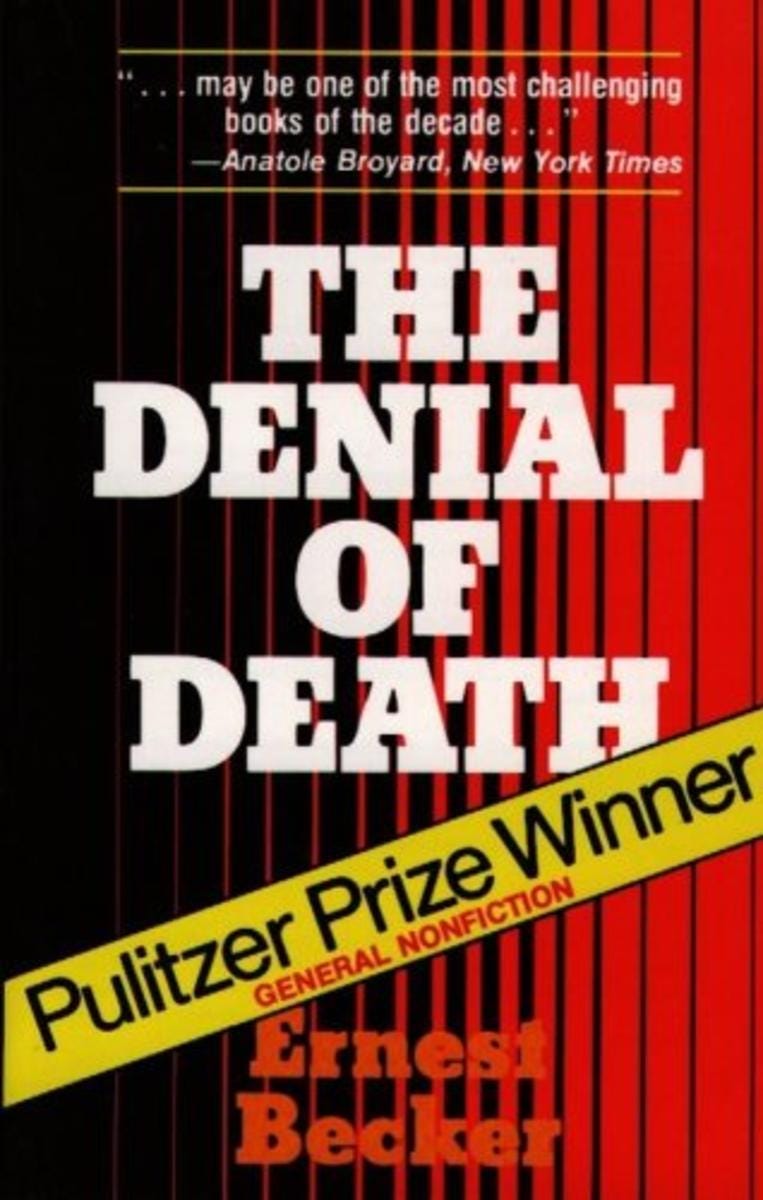
When we were first married, my wife found this interest in death morbid and alarming. She took my copy of Jonathan Kozol’s “Death at an Early Age” and hid it, not realizing that the book was about inner city education and not literal death. Somehow she missed my copy of Ernest Becker’s Pulitzer-winning “The Denial of Death,” a book that had a huge influence on me, probably more than anything else I have read on the subject.
In truth, while an obsession with death is not healthy, thinking about death—even fairly often, as one grows older—is really a way of thinking about life. It helps us to sharpen our sense of priorities, decide what is worth bothering with and what not (including which people to bother with in some cases), and make decisions about things we want to do now rather than later, because the obvious hard truth is that there might not be a later.
There’s another aspect to thinking about death, and this is the one I was reminded of this morning when I saw that book review about Paris’s hidden river. I have a whole world of experiences in my head—or more scientifically, in my brain—that will die with me when I go. So do we all. People I have known, places I have been, good things that happened, bad things that happened, the whole tapestry of life.
I remember taking a lone walk by the sea on a trail on Belle Isle in Brittany; I remember being stuck in the middle of Kenya’s Rift Valley in a broken down SUV; I remember the day I first met my wife and exactly what I thought when I saw her.
I remember friends who are now gone, the things we shared, and many of the conversations I had with them. Those memories, like all of the memories crammed into my head, are mine and mine alone. But as vivid as they are, as easily as I can recreate places and faces and events in my mind (my memory is strongly visual, I understand that is not true for all people), in reality they are nothing more than configurations of molecules in my brain and the firing of neurons making connections between one image and thought and another.
I don’t know about you, but I find this to be the hardest thing to accept—that all of this dies with us when we take our last breaths. Oh, perhaps it will take another hour or two for the brain cells to die completely—whatever the science says, I am not particularly curious because once it happens it is too late anyway—but unlike computers, our brains don’t have backup drives where we can store it all.
Maybe one day? I think I have seen one or two science fiction movies where technicians do download your brain, and I’ve heard about mind uploading, but I’m not sure I like the idea (mind without body cannot be all that much fun) and anyway none of this is likely to happen in my lifetime.
But wait! There is one thing—I am a writer! And over half a century I have written about many of my experiences in newspapers and magazines and blogs and this Substack newsletter. Does this mean I will live on long after I die?
Perhaps, in a way, for those who find what I had to say interesting. But for me personally, of course not.
I'm thinking this is probably a good place to end this post because I am meandering into territory I am not really equipped to deal with. Perhaps a better use of my time would be to go out and have more experiences. My wife is just finishing up an online class and she is very interesting to talk to, and I hear a cat meowing—she probably wants more food.
Oh gosh, do cats think? What do they think about?
Uh oh. Goodbye for now.
**********************************************************************************************************
To share this post, or to share “Words for the Wise,” please click on these link.
Your writing continues to improve the quality of life for many of us. Thank you.
.. of the mouse in your cellar!